Tutorials
How to design APIs to be found by AI agents
Learn how to design APIs to be found by AI agents with this step-by-step guide. Enhance API discoverability and ensure GDPR-ready compliance for enterprise use.

NI
Nikolas Dimitroulakis
Last updated on December 29, 2025
How to Design APIs to Be Found by AI Agents Easily
Most API documentation in American tech startups misses a critical opportunity. As automation and intelligent integration become the norm, over 80 percent of APIs lack metadata optimized for AI agent discovery, resulting in missed connections and slow adoption. Designing APIs for intelligent systems is more than technical specs. This guide reveals how to structure metadata and documentation so AI agents can instantly understand your API, improving automation and compliance across international borders.
Table of Contents
- Step 1: Define API Metadata For AI Agent Discovery
- Step 2: Implement Standardized, Machine-Readable Documentation
- Step 3: Enforce Compliance And Data Sovereignty Controls
- Step 4: Integrate Enterprise-Ready Authentication And Auditing
- Step 5: Test AI Discoverability And Verify Compliance Readiness
Quick Summary
| Key Insight | Explanation |
|---|---|
| 1. Focus on Comprehensive Metadata | Develop detailed API metadata that captures technical specifications and contextual meaning for AI agents. |
| 2. Use Standardized Documentation | Implement machine-readable formats like JSON-LD or OpenAPI for better AI interaction and understanding. |
| 3. Ensure Compliance with Data Laws | Integrate robust data sovereignty and compliance controls to manage data processing and protect user information. |
| 4. Create Security through Authentication | Design enterprise-level authentication systems to secure API access and allow for detailed auditing of interactions. |
| 5. Test AI Discoverability Regularly | Establish a verification process to assess your API's discoverability by AI systems and ensure compliance with regulations. |
Step 1: Define API metadata for AI agent discovery
Designing metadata specifically for AI agent discovery requires strategic thinking about how intelligent systems interpret and interact with your API's description. The goal is to create a comprehensive semantic description that allows AI agents to understand not just the technical specifications, but the contextual meaning and potential applications of your API.
Metadata management forms the cognitive foundation that enables AI agents to reason, execute, and plan interactions with your API. By integrating descriptive, structural, administrative, and semantic metadata, you create a rich metadata framework that enhances contextual understanding for intelligent systems. This means crafting detailed descriptions that go beyond basic technical documentation to include nuanced information about data types, input requirements, expected outputs, and potential use cases.
To effectively design metadata for AI agent discovery, focus on creating a structured yet comprehensive description. Include clear annotations about the API's domain, purpose, input parameters, response formats, and potential integration scenarios. Leverage standard metadata schemas like JSON LD or Schema.org to provide machine-readable context that AI agents can quickly parse and understand. Your metadata should explicitly define the API's capabilities, limitations, authentication methods, and any specific semantic relationships between different data elements.
Pro tip: Treat your API metadata like a detailed technical resume for an intelligent system, providing enough context and specificity that an AI agent can autonomously evaluate its potential usefulness without human intervention.
Step 2: Implement standardized, machine-readable documentation
Implementing standardized machine-readable documentation is crucial for enabling AI agents to efficiently discover, understand, and interact with your API. Your goal is to create a structured, comprehensive documentation format that allows intelligent systems to automatically parse and comprehend your API's capabilities and specifications.
To achieve this, leverage advanced machine-readable metadata formats designed for AI system interoperability. These frameworks go beyond traditional documentation by providing a systematic approach to describing APIs that intelligent agents can easily read and interpret. Consider adopting standards like JSON LD, OpenAPI Specification (formerly Swagger), or emerging protocols like Croissant-RAI that are specifically engineered to enhance automatic metadata processing and discovery.
When developing your machine-readable documentation, focus on creating comprehensive, structured descriptions that cover technical specifications, input parameters, response formats, authentication methods, and potential use cases. Include explicit semantic annotations that provide context about your API's domain, functional capabilities, and integration potential. Ensure your documentation follows established schemas that support automatic parsing, allowing AI agents to quickly understand the API's purpose, constraints, and potential applications without requiring manual interpretation.
Pro tip: Design your API documentation as if an intelligent system with zero human context will be reading it completely autonomously, providing every possible detail that might help an AI agent understand and evaluate your API's utility.
Here's how key API documentation standards compare for AI agent discovery:
| Standard | Machine Readability | Semantic Context | AI Integration Strength |
|---|---|---|---|
| OpenAPI | Strong | Moderate | Widely adopted |
| JSON-LD | Excellent | High | Great for linked data |
| Schema.org | Good | Very High | Supports rich metadata |
| Croissant-RAI | Emerging | Advanced | Tailored for AI agents |
Step 3: Enforce compliance and data sovereignty controls
Enforcing compliance and data sovereignty controls is critical for ensuring your API meets international regulatory requirements and protects user data across different jurisdictional boundaries. Your primary objective is to implement robust mechanisms that transparently manage data processing, storage, and transit while maintaining strict adherence to global data protection standards.
Comprehensive data sovereignty frameworks require careful examination of technological and economic challenges associated with cross border data management. This means implementing detailed audit processes that track data origin, user location, and processing pathways. APIs must be designed with built-in controls that allow granular management of data storage locations, processing constraints, and local regulatory compliance mechanisms. Enterprises need to develop sophisticated approaches that balance performance requirements with stringent data protection protocols.
To effectively enforce compliance, your API should integrate transparent policies that clearly communicate data handling practices. APIs must proactively address international data sovereignty laws by embedding clear mechanisms for tracking data movement and processing. This includes implementing cryptographic measures, defining explicit data storage jurisdictions, and creating flexible authentication systems that can adapt to different regional regulatory environments. Develop comprehensive documentation that outlines your data sovereignty strategy, including specific details about data residency, processing locations, and the security measures protecting user information across different regulatory landscapes.
Pro tip: Consider developing a modular compliance framework that can be easily reconfigured to meet emerging international data protection regulations without requiring complete API redesigns.
Step 4: Integrate enterprise-ready authentication and auditing
Designing an enterprise-ready authentication and auditing system for your API requires implementing robust security mechanisms that protect sensitive resources while providing comprehensive visibility into system access and interactions. Your goal is to create a sophisticated authentication framework that supports complex organizational needs and enables secure, traceable interactions for both human users and AI agents.
[Enterprise-grade authentication platforms support centralized user management through advanced features like Single Sign-On (SSO) and Role-Based Access Control] that streamline security processes. This means implementing comprehensive identity management systems that can handle complex permission structures, integrate with existing enterprise directories, and provide granular control over system access. By developing a flexible authentication mechanism, you ensure that your API can accommodate diverse user types while maintaining strict security protocols that prevent unauthorized access and potential data breaches.
Modern API frameworks enable sophisticated authentication strategies using OAuth2, comprehensive auditing mechanisms, and enterprise-level security integrations. Your implementation should focus on creating layered security approaches that include multi factor authentication, detailed logging of all access attempts, and intelligent threat detection capabilities. This requires designing authentication workflows that not only verify user identities but also continuously monitor and record interaction patterns, providing a complete audit trail that supports both immediate security management and long term compliance requirements.
Pro tip: Build authentication systems with modular design principles that allow easy integration of new identity providers and seamless adaptation to evolving security standards without requiring complete infrastructure redesigns.
Here is a summary of robust API compliance and security controls:
| Control Type | Primary Purpose | Key Tools/Methods |
|---|---|---|
| Data Sovereignty | Protect data across borders | Location tracking, audit |
| Authentication | Restrict and monitor access | SSO, OAuth2, RBAC |
| Compliance Auditing | Ensure regulatory adherence | Automated scanning tools |
| Encryption | Secure data in transit and storage | TLS, database encryption |
Step 5: Test AI discoverability and verify compliance readiness
Testing AI discoverability and verifying compliance readiness requires a comprehensive approach that systematically evaluates your API's ability to be discovered, understood, and interacted with by intelligent agents while ensuring strict adherence to regulatory standards. Your objective is to create a robust verification process that validates both technical compatibility and regulatory compliance across multiple dimensions.
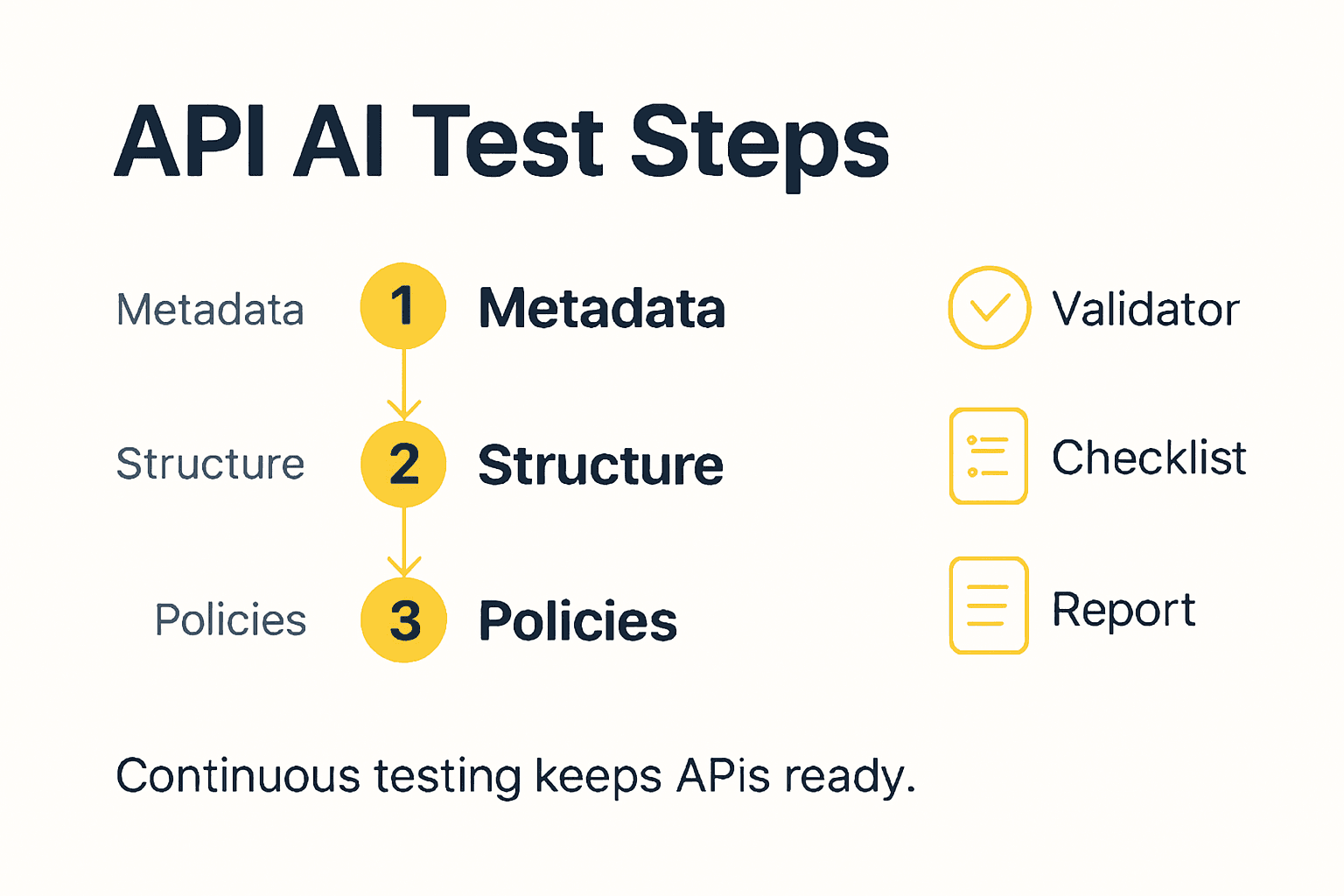
Advanced testing strategies now leverage AI-powered compliance automation tools that can analyze API design governance and generate comprehensive verification reports. This means implementing sophisticated testing frameworks that go beyond traditional validation methods, utilizing intelligent systems capable of automatically detecting potential compliance gaps, semantic inconsistencies, and structural vulnerabilities in your API documentation and design. Your verification process should incorporate multiple layers of testing, including automated compliance scanning, semantic analysis, and simulated AI agent interactions to ensure comprehensive discoverability and regulatory alignment.
To effectively test AI discoverability, develop a multi stage verification protocol that systematically evaluates your API across different dimensions. This includes conducting thorough semantic parsing tests, validating metadata comprehensiveness, assessing machine readability, and simulating AI agent discovery scenarios. Create test suites that challenge your API's ability to communicate its purpose, capabilities, and constraints clearly and unambiguously, ensuring that intelligent agents can autonomously understand and potentially interact with your API without human intervention. Focus on creating detailed, structured metadata that provides rich contextual information while maintaining precise technical specifications.
Pro tip: Develop a continuous compliance testing framework that automatically monitors and updates your API documentation to maintain optimal discoverability and regulatory alignment as technological standards and requirements evolve.
Unlock Seamless AI Agent Integration with Ready-to-Use APIs
Designing APIs that AI agents can easily discover and interact with requires clear metadata, standardized machine-readable documentation, and strong compliance controls. The challenge lies in creating APIs that not only meet technical specs but also speak the language of intelligent systems without manual intervention. If you want to avoid the complexity of building every integration from scratch while ensuring your APIs are equipped for AI agent discovery, consider leveraging reliable APIs that are crafted with these principles in mind.
At ApyHub, we offer over 150 ready-to-use APIs covering AI document understanding, text analysis, data extraction, file conversion, and more. These APIs come with well-structured, machine-readable metadata designed to support seamless AI integrations and compliance readiness. Whether you are focused on improving your API's discoverability or securing it with enterprise-grade authentication, our API catalog provides practical solutions that accelerate your development and reduce maintenance overhead.
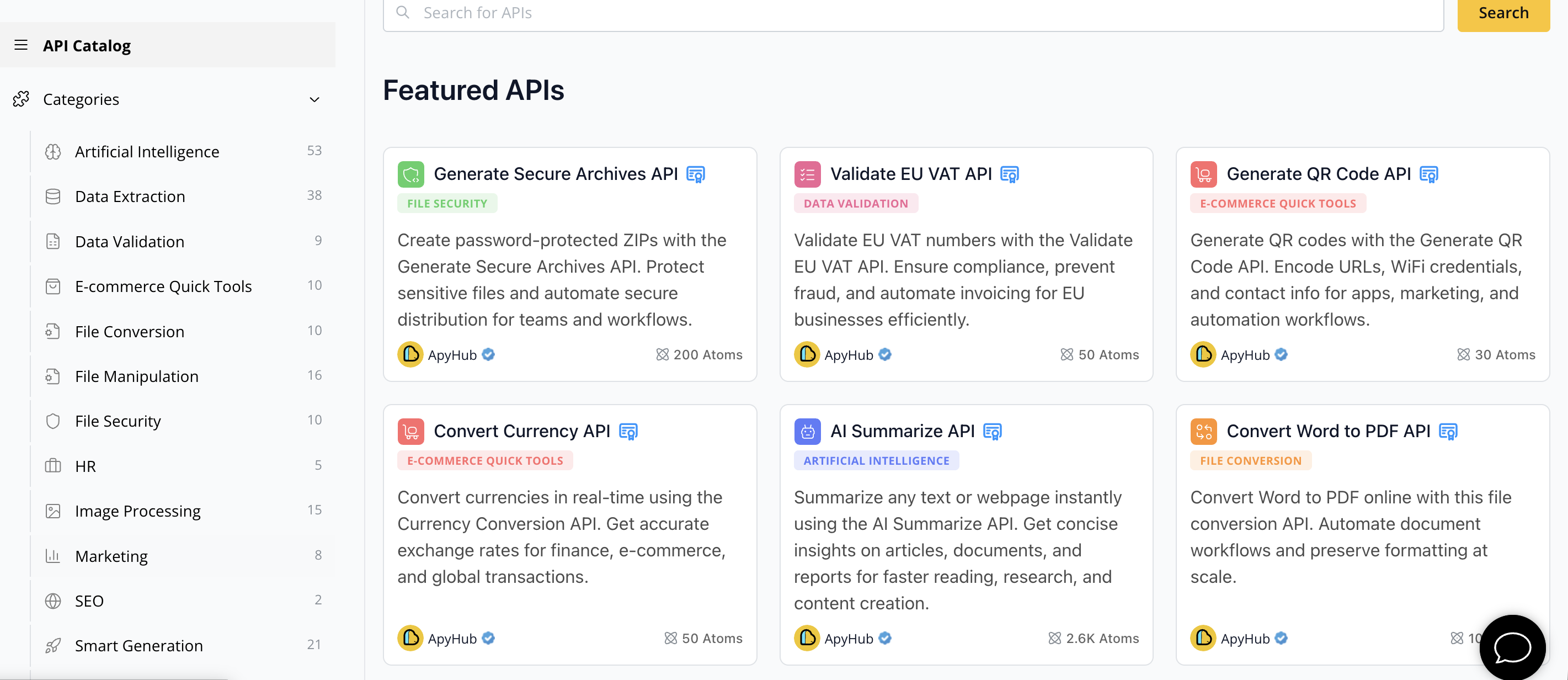
Explore how our marketplace delivers trustworthy APIs optimized for AI agent interaction and compliance enforcement. Visit the ApyHub API catalog today and start building smarter integrations that meet tomorrow’s AI-driven demands.
Frequently Asked Questions
How can I create effective API metadata for AI agents?
To create effective API metadata, focus on providing a comprehensive semantic description that goes beyond basic technical details. Include information about data types, input parameters, response formats, and specific use cases to help AI agents understand the context of your API. Treat your API metadata like a detailed resume for an intelligent system, ensuring it includes all relevant information for autonomous evaluation.
What formats should I use for machine-readable API documentation?
For machine-readable API documentation, utilize standardized formats such as JSON-LD, OpenAPI Specification, or emerging protocols like Croissant-RAI. These frameworks enhance automatic metadata processing and allow AI agents to easily parse and comprehend your API’s specifications. Aim to create a consistent documentation format that clearly outlines all aspects of your API.
How can I ensure my API complies with data sovereignty regulations?
To ensure compliance with data sovereignty regulations, implement robust data management controls regarding data processing and storage. Clearly communicate data handling practices in your documentation and embed mechanisms to track data movement and processing locations. Develop a modular compliance framework that can adapt to emerging regulations without needing a complete redesign.
What authentication methods are best for enterprise-ready APIs?
For enterprise-ready APIs, implement advanced authentication methods such as Single Sign-On (SSO) and Role-Based Access Control (RBAC). These methods enhance security by allowing centralized user management and provide granular control over access. Ensure your authentication framework is flexible enough to accommodate various user types and evolving security standards.
How do I test for AI discoverability in my API?
To test for AI discoverability, develop a multi-stage verification process that evaluates your API’s metadata comprehensiveness and machine readability. Conduct semantic parsing tests and simulate AI agent interactions to ensure that your API communicates its capabilities clearly and effectively. Focus on creating a structured metadata framework that facilitates easy understanding by intelligent systems.
What steps should I take to maintain compliance readiness over time?
To maintain compliance readiness, establish a continuous compliance testing framework that automatically monitors your API documentation and functionality. Regularly update your API to align with evolving technological standards and regulatory requirements. Aim for quarterly reviews to ensure your compliance strategies remain effective and relevant.