
API Marketplace Explained: Speed Up Product Delivery
More than 65 percent of American tech startups now rely on API marketplaces to speed up integration and lower development headaches. For software developers and product managers, the pressure to deliver seamless automation while managing tight resources is a global priority. Knowing the facts behind API marketplaces and separating myths from reality will help your team build faster, smarter systems with fewer surprises along the way.
01Table of Contents
- API Marketplace Basics And Common Myths
- Core Types And Categories Of APIs Available
- How API Marketplaces Streamline Integration
- Real-World API Marketplace Use Cases For Teams
- Risks, Challenges, And Security Considerations
- Comparing API Marketplaces To Alternatives
02Key Takeaways
| Point | Details |
|---|---|
| API Marketplaces Enhance Development | Modern API marketplaces simplify integration processes, enabling rapid adoption of sophisticated APIs while reducing development complexities. |
| Diverse API Categories Available | These platforms host a wide range of APIs tailored to specific business needs, empowering developers with pre-built solutions. |
| Strategic Security is Crucial | API marketplaces introduce unique security challenges; a proactive security strategy is essential to protect digital infrastructure. |
| Choose Quality Over Quantity | When selecting an API marketplace, prioritize platforms with comprehensive documentation, robust security protocols, and transparent pricing models for optimal integration success. |
03API marketplace basics and common myths
API marketplaces represent sophisticated digital platforms designed to transform how developers discover, integrate, and leverage APIs as scalable business services. Unlike traditional API documentation portals, these centralized hubs facilitate a comprehensive ecosystem where API providers and consumers can seamlessly connect, negotiate, and transact.
Key characteristics of modern API marketplaces include robust features that extend beyond simple technical interfaces. They provide comprehensive solutions like detailed documentation, security protocols, analytics tracking, and subscription management. These platforms enable businesses to package APIs as valuable products, creating revenue streams while simplifying complex integration processes for developers. Public and private marketplace models exist, each tailored to specific organizational requirements and developer needs.
Common myths surrounding API marketplaces often stem from misunderstandings about their purpose and functionality. Many developers mistakenly believe these platforms are merely technical repositories, when in reality they represent strategic business tools. Some prevalent misconceptions include:
- API marketplaces are just technical directories
- Only large enterprises can benefit from marketplace solutions
- API integration is always complex and time-consuming
- Marketplace APIs lack robust security features
In practice, API marketplaces democratize technological access, allowing startups and enterprises alike to rapidly discover, evaluate, and implement sophisticated API solutions without extensive development overhead.
Pro tip: When exploring API marketplaces, prioritize platforms offering comprehensive documentation, transparent pricing models, and robust developer support to maximize your integration success.
04Core types and categories of APIs available
API marketplaces host a diverse ecosystem of APIs designed to solve complex business and technical challenges across multiple domains. Developers can now access specialized data extraction APIs that streamline information gathering and processing workflows, enabling more efficient and intelligent application development.
The core categories of APIs typically encompass several critical functional domains:
- Commerce APIs: Enabling payment processing, currency conversion, transaction management. Try the Commerce APIs here.
- AI Document APIs: Supporting intelligent document parsing, data extraction, and information classification
- AI Text Processing APIs: Facilitating natural language understanding, sentiment analysis, text moderation
- AI Image and Video Analysis APIs: Providing computer vision capabilities like object recognition, content moderation
- Data Extraction APIs: Supporting web scraping, metadata retrieval, complex information parsing
- File Conversion APIs: Enabling seamless transformations between different document and media formats. Try the Conversion APIs here.
- File Security APIs: Managing thumbnail generation, digital watermarking, document protection
Each API category addresses specific technological challenges, allowing developers to rapidly integrate sophisticated functionalities without building complex systems from scratch. These pre-built solutions dramatically reduce development time and technical complexity, empowering teams to focus on core product innovation.

Modern API marketplaces offer granular, purpose-built solutions that go beyond generic implementations. Developers can select highly specialized APIs that precisely match their project requirements, whether they need advanced machine learning capabilities, precise data transformations, or robust security protocols.
To clarify the roles of major API categories, here is a quick reference for common business needs:
| API Category | Common Use Case | Business Value |
|---|---|---|
| Commerce APIs | Enable secure online payments | Streamlined transactions |
| AI Document APIs | Automate data extraction from files | Reduce manual data entry |
| AI Image/Video APIs | Detect objects in images | Enhance product features |
| Data Extraction APIs | Scrape and organize web content | Accelerate data analysis |
| File Security APIs | Protect sensitive documents | Minimize information exposure |
Pro tip: When exploring API categories, prioritize solutions with comprehensive documentation, flexible pricing models, and robust authentication mechanisms to ensure smooth integration and scalability.
05How API marketplaces streamline integration
API marketplaces revolutionize the software development landscape by simplifying complex integration processes through carefully curated technological ecosystems. These platforms transform traditionally challenging integration workflows by providing developers with centralized, intuitive interfaces that aggregate high-quality, pre-vetted APIs with comprehensive documentation and support.
The integration streamlining process involves multiple strategic mechanisms:
- Centralized Discovery: Developers can quickly search and evaluate APIs across multiple categories
- Comprehensive Documentation: Detailed guides, example code, and SDK resources accompany each API
- Built-in Testing Environments: Sandboxed spaces allow developers to experiment without production risks
- Standardized Authentication: Uniform security protocols simplify credential management
- Subscription Management: Flexible pricing and usage tracking reduce administrative overhead
These marketplaces dramatically reduce technical complexity by eliminating the traditional barriers associated with API integration. Developers no longer need to spend weeks researching, negotiating, and implementing custom integrations. Instead, they can select pre-validated APIs that precisely match their project requirements, dramatically accelerating development timelines.
Modern API marketplaces go beyond simple API listings by providing intelligent matching algorithms, performance analytics, and robust support infrastructure. They effectively transform API integration from a complex, time-consuming process into a streamlined, efficient workflow that empowers development teams to focus on core product innovation.
Here's a summary of how API marketplaces streamline integration versus traditional methods:
| Aspect | API Marketplaces | Traditional Integration |
|---|---|---|
| Discovery | Centralized, curated search | Manual research required |
| Testing | Built-in sandbox environments | Custom test setups needed |
| Documentation Access | Comprehensive, standardized | Often fragmented |
| Support | Platform-mediated assistance | Limited or vendor-specific |
| Integration Speed | Rapid, pre-validated APIs | Slower, custom development |
Pro tip: Always thoroughly review API documentation, test in sandbox environments, and evaluate performance metrics before final production integration.
06Real-world API marketplace use cases for teams
Development teams across various industries are leveraging API marketplaces to transform their technological capabilities and accelerate product innovation. These platforms enable organizations to quickly access specialized APIs that solve complex business challenges without extensive in-house development.
Key real-world use cases span multiple critical business domains:
- Social Media Integration: Connecting platforms for brand engagement and analytics
- Financial Automation: Streamlining transaction processing and payment workflows
- E-commerce Logistics: Managing inventory, shipping, and order tracking systems
- Healthcare Data Management: Securely integrating patient records and medical information
- Machine Learning Enhancements: Adding intelligent features like recommendation engines
- Customer Support: Implementing chatbots and intelligent communication systems
- Marketing Analytics: Tracking user behavior and generating comprehensive insights
These API marketplace applications dramatically reduce development complexity by providing pre-built, scalable solutions. Instead of spending months building custom integrations, teams can rapidly prototype and deploy sophisticated technological capabilities, allowing them to focus on core product differentiation and strategic innovation.
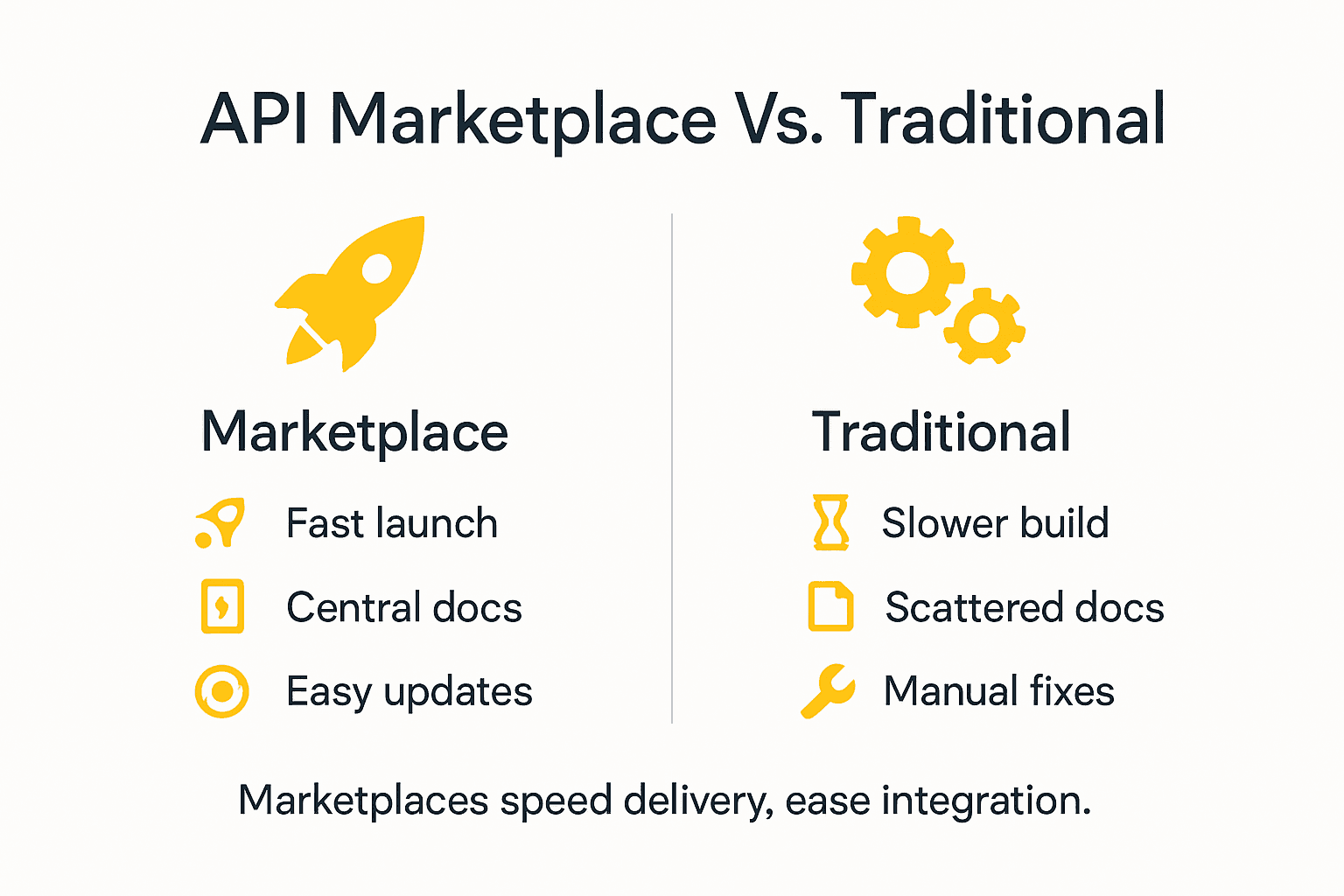
Modern organizations increasingly view API marketplaces as strategic acceleration platforms. By accessing vetted, high-performance APIs, teams can experiment faster, reduce technical debt, and create more agile development environments that respond quickly to changing market demands.
Pro tip: Always conduct thorough performance testing and review API documentation to ensure seamless integration and optimal system compatibility.
07Risks, challenges, and security considerations
API marketplaces introduce complex security challenges that require sophisticated and proactive management strategies. Cybersecurity experts highlight significant risks inherent in API ecosystems, emphasizing the critical need for comprehensive security frameworks to protect digital infrastructure.
The primary security risks in API marketplaces can be categorized into several key domains:
- Access Control Vulnerabilities: Weak authentication mechanisms enabling unauthorized system entry
- Data Exposure Threats: Potential unintended information leakage through improperly configured APIs
- Authentication Weaknesses: Insufficient identity verification processes
- Injection Attack Risks: Potential for malicious code insertion
- Scalability Security Challenges: Complexity of managing security across multiple API integrations
Effective security strategies demand a multilayered approach that goes beyond traditional perimeter defenses. Organizations must implement robust identity and access management protocols, including zero-trust models, multi-factor authentication, and continuous monitoring systems that can detect and respond to potential security anomalies in real-time.
Comprehensive API security requires ongoing vigilance, combining technological safeguards with strategic governance. This includes regular vulnerability assessments, implementing encryption standards, establishing strict rate limiting, and maintaining detailed audit trails to track and prevent potential security breaches.
Pro tip: Conduct quarterly comprehensive security audits and maintain an up-to-date inventory of all API integrations to proactively identify and mitigate potential vulnerabilities.
08Comparing API marketplaces to alternatives
Development teams seeking efficient technological solutions must carefully evaluate different API integration approaches. Modern API marketplaces represent a sophisticated evolution beyond traditional integration methods, offering comprehensive services that significantly streamline technological adoption.
Key differences between API marketplaces and alternative approaches include:
- API Directories: Static listings without advanced features
- Integration Platforms: Workflow connectors with limited discovery capabilities
- Custom Development: Time-consuming and resource-intensive solutions
- Open-Source Libraries: Limited support and potential maintenance challenges
API marketplaces distinguish themselves through several critical advantages. Unlike simple directories, these platforms provide robust ecosystem services including API productization, comprehensive security enforcement, monetization options, and advanced user engagement tools. They create centralized environments where developers can rapidly discover, evaluate, and integrate sophisticated technological solutions.
The strategic value of API marketplaces extends beyond mere technical connectivity. These platforms fundamentally transform how organizations approach technological innovation, offering standardized integration models that reduce complexity, mitigate risks, and accelerate digital transformation. By providing curated, pre-validated APIs with extensive documentation and support, marketplaces enable faster product development and more agile technological strategies.
Pro tip: Evaluate API marketplace solutions holistically by assessing documentation quality, security features, pricing models, and community support rather than focusing solely on technical specifications.
09Accelerate Your Product Delivery with ApyHub’s Ready-to-Use APIs
The article highlights common challenges developers face in navigating complex API marketplaces and costly custom integrations. If you want to eliminate the headache of lengthy development and testing cycles, ApyHub offers a powerful solution. Our extensive API marketplace features over 150 reliable, ready-to-use APIs across essential categories like commerce, AI document understanding, data extraction, and file conversion. This makes it easier for product teams, startups, and enterprises to quickly find the right tools and integrate them seamlessly into real-world workflows.
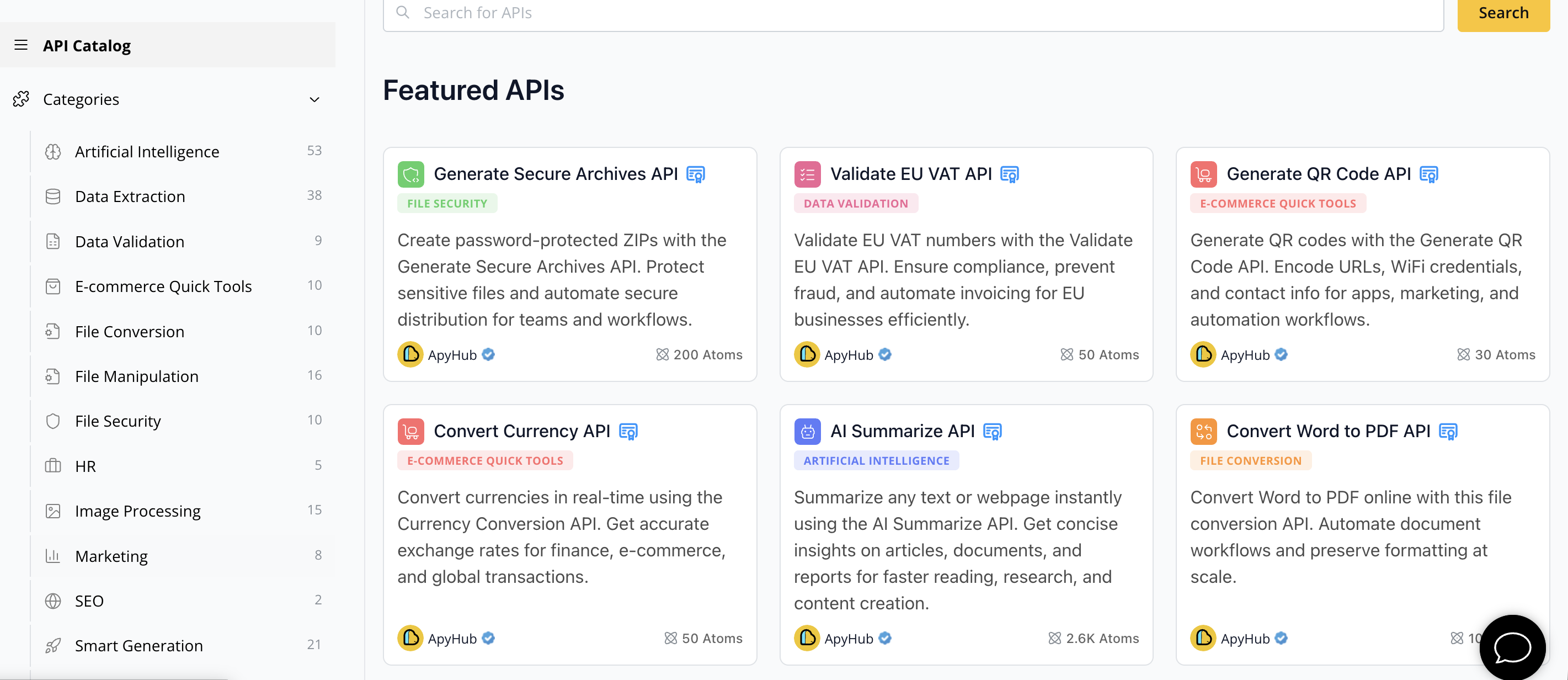
Get ahead of the competition by reducing development time and cutting maintenance burdens with ApyHub. Explore our curated collection to unlock practical integration patterns and accelerate your product delivery. Start transforming your ideas into working solutions now by visiting ApyHub API Catalog and discover how easy it is to build faster with trusted APIs.
10Frequently Asked Questions
What are API marketplaces?
API marketplaces are digital platforms that connect API providers and consumers, enabling seamless discovery, integration, and transaction of APIs as business services.
How do API marketplaces simplify integration processes?
API marketplaces streamline integration by offering centralized discovery, comprehensive documentation, built-in testing environments, standardized authentication, and subscription management, reducing complexity and development time.
What types of APIs can I find in an API marketplace?
API marketplaces host various types of APIs, including Commerce APIs for payments, AI Document APIs for data extraction, AI Text Processing APIs for natural language understanding, and more specialized categories tailored for specific business needs.
What security considerations should I keep in mind when using an API marketplace?
Security considerations in API marketplaces include access control vulnerabilities, data exposure threats, authentication weaknesses, and potential injection attack risks. It's crucial to implement robust security protocols, monitor APIs continually, and conduct regular audits.