
IP Addresses: Private Ranges, Geolocation, Security Impact
Nearly every american tech startup relies on IP addresses to keep global applications running smoothly. With over 4.3 billion IPv4 addresses nearly exhausted worldwide, developers must navigate complex addressing, geolocation, and security tasks just to maintain secure connections for users from Germany to Brazil. If you want clearer insights into IP fundamentals, private ranges, geolocation, modern protection methods, and API integration, this guide covers the practical essentials for efficient and secure network management.
01Table of Contents
- IP Address Fundamentals In Modern Networking
- Private IP Address Ranges And Limitations
- Geolocating IP Addresses With APIs
- Securing And Hiding IP Addresses Effectively
- Integrating IP Address APIs In Developer Workflows
02Key Takeaways
| Point | Details |
|---|---|
| IP Address Importance | IP addresses are essential for device communication in networking, acting as unique identifiers for routing and connectivity. |
| IPv4 vs. IPv6 | IPv4 is limited with 32-bit addresses, while IPv6 offers an extensive 128-bit address space, supporting the growth of connected devices. |
| Private IP Addresses | Private IP addresses enhance security by enabling internal communication without exposure to the public internet, leveraging NAT for protection. |
| Geolocation and Privacy | Utilizing geolocation APIs can improve user experience, but developers must prioritize privacy regulations and ethical data practices. |
03IP Address Fundamentals in Modern Networking
In the complex world of digital communication, IP addresses serve as the foundational identifiers that enable seamless global connectivity. These unique numerical labels are critical for routing data across interconnected networks, allowing devices to communicate effectively worldwide. Coursera researchers explain that an IP address represents a distinctive number assigned to any device connecting to the internet, functioning as a digital passport for network communication.
IP addresses operate through two primary versions: IPv4 and IPv6. Wikipedia notes that IPv4 uses 32-bit addresses, which have become increasingly limited due to the explosive growth of internet-connected devices. To address this constraint, IPv6 emerged with 128-bit addresses, dramatically expanding the potential number of unique network identifiers. This technological evolution enables more devices to connect simultaneously while maintaining precise routing capabilities.
The architecture of IP addresses involves several key components that facilitate network communication. These include:
- Network Prefix: Identifies the specific network segment
- Host Number: Pinpoints the exact device within that network
- Subnet Mask: Determines network boundaries and routing parameters
Modern networks leverage CIDR notation (Classless Inter-Domain Routing) to enhance IP address allocation efficiency. This method allows network administrators to create more flexible and granular subnet configurations, optimizing network resource management and improving overall communication infrastructure.
Pro tip: When configuring network settings, always double-check your subnet mask and network prefix to ensure optimal routing and prevent potential communication disruptions.
Here is a comparison of IPv4 and IPv6 addressing features:
| Characteristic | IPv4 | IPv6 |
|---|---|---|
| Address Length | 32 bits | 128 bits |
| Format Example | 192.0.2.1 | 2001:0db8:85a3::8a2e:0370:7334 |
| Number of Addresses | About 4.3 billion | Virtually unlimited |
| Common Usage | Legacy networks, most devices | Modern networks, future growth |
| Address Exhaustion | Nearly depleted | Not depleted |
04Private IP Address Ranges and Limitations
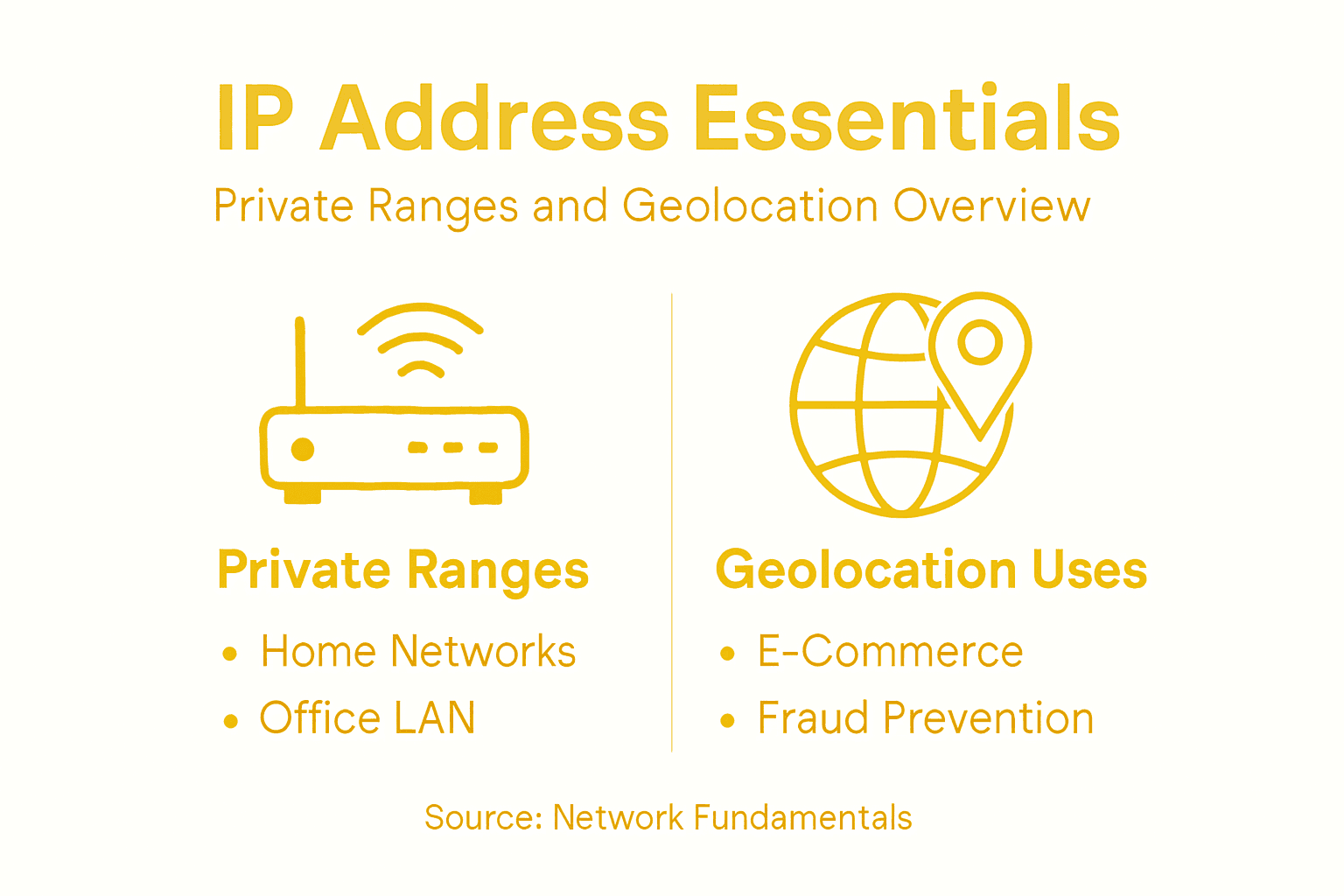
Private IP addresses form a critical component of network architecture, providing organizations with secure and flexible internal communication strategies. Geeks for Geeks explains that these specialized network identifiers are designed for local network use, offering enhanced security by preventing direct exposure to the public internet. Unlike public IP addresses, private IP ranges are non-routable, meaning they cannot be directly transmitted across the global internet backbone.
The Internet Assigned Numbers Authority (IANA) has officially defined three primary private IP address ranges that organizations can utilize for internal network design:
- 10.0.0.0/8: Largest range, supporting up to 16,777,216 unique addresses
- 172.16.0.0/12: Medium-sized range with 1,048,576 possible addresses
- 192.168.0.0/16: Smallest range, offering 65,536 potential network configurations
These private IP ranges enable network administrators to create isolated network segments, support complex network topologies, and implement robust security measures. By using Network Address Translation (NAT), organizations can map private IP addresses to a single public IP, effectively hiding internal network infrastructure from external threats. This approach provides an additional layer of security while allowing multiple devices to share a single public internet connection.
Understanding the limitations of private IP ranges is crucial for effective network design. While these ranges offer significant flexibility, they are restricted to local network environments and require special routing techniques to interact with external networks. Proper subnet configuration, careful IP address allocation, and strategic network segmentation are essential for maximizing the potential of these reserved address spaces.
Pro tip: When designing network architectures, always plan your private IP address allocation strategically to avoid potential address conflicts and ensure optimal network scalability.
05Geolocating IP Addresses With APIs
IP geolocation has become an essential technique for developers seeking to extract precise geographic information from network addresses. Mozilla's developer documentation reveals that modern geolocation technologies can retrieve location data through multiple sources, including GPS, WiFi networks, and IP address tracking. This sophisticated approach allows applications to understand user location with remarkable accuracy and minimal user intervention.
Geolocation APIs provide developers with comprehensive tools for extracting detailed geographic metadata. IP geolocation services typically return rich information such as:
- Country and region details
- City-level precision
- Latitude and longitude coordinates
- Internet Service Provider (ISP) information
- Autonomous system network details
- Timezone and connection type
The practical applications of IP geolocation APIs are vast and transformative across multiple industries. E-commerce platforms can customize pricing and shipping options, cybersecurity teams can detect potential fraud attempts, content providers can implement region-specific content delivery, and marketing teams can create targeted, location-based advertising campaigns. By leveraging these APIs, organizations can create more personalized, secure, and efficient digital experiences.
Implementing IP geolocation requires careful consideration of privacy regulations and user consent. While these APIs provide powerful insights, developers must balance technological capabilities with ethical data collection practices. Transparent communication about data usage, implementing robust security measures, and allowing user opt-out mechanisms are crucial for maintaining trust and compliance with international data protection standards.
Pro tip: Always implement server-side IP geolocation validation to prevent potential spoofing and ensure the most accurate location data.
06Securing and Hiding IP Addresses Effectively
Online privacy has become a critical concern for internet users seeking to protect their digital identity. Security experts recommend multiple sophisticated techniques for masking and protecting IP addresses, each offering unique advantages in maintaining digital anonymity. The primary methods of IP address protection include virtual private networks (VPNs), proxy servers, and specialized anonymity browsers that effectively obscure a user's true network identity.
Modern IP protection strategies typically involve several key approaches:
- VPN Technologies: Replace your original IP with an encrypted connection
- Proxy Servers: Route traffic through intermediate servers
- Tor Browser: Anonymize traffic by routing through multiple international relays
- Residential Proxies: Use legitimate residential IP addresses for enhanced camouflage
- Network Segmentation: Isolate sensitive network resources
The National Security Agency's network security guidance emphasizes the importance of comprehensive network protection beyond simple IP masking. Effective IP security requires a multilayered approach that combines technological tools with robust security practices. This means implementing strong authentication mechanisms, regularly updating network infrastructure, and maintaining vigilant monitoring of potential vulnerabilities.
Implementing IP protection is not just about hiding your address but creating a comprehensive digital defense strategy. Cybersecurity professionals recommend combining technical solutions with informed online behavior. This includes using encrypted communication channels, avoiding suspicious websites, implementing strong password practices, and maintaining updated security software. By adopting a holistic approach to digital privacy, users can significantly reduce their exposure to potential online threats and maintain greater control over their digital footprint.
Pro tip: Rotate your IP protection methods periodically and never rely on a single anonymity technique to ensure comprehensive online privacy.
The table below summarizes common IP protection methods and their privacy benefits:
| Protection Method | How It Works | Privacy Benefit |
|---|---|---|
| VPN | Encrypts and masks traffic | Hides true IP address |
| Proxy Server | Routes traffic externally | Bypasses content filters |
| Tor Browser | Uses multiple relays | Enhanced anonymity |
| Residential Proxy | Mimics real user traffic | Avoids detection |
07Integrating IP Address APIs in Developer Workflows
Web APIs have revolutionized how developers handle network-related tasks, providing streamlined solutions for complex IP address management challenges. Modern web development APIs enable developers to access sophisticated network functionalities through simple, standardized interfaces that abstract away intricate technical complexities. This approach dramatically reduces development time and increases the reliability of network-related application features.
IP address API integration typically involves several key implementation strategies:
- Direct HTTP Requests: Retrieve IP information via RESTful endpoints
- Client-Side JavaScript: Fetch real-time IP data without page reloads
- Server-Side Processing: Implement comprehensive IP tracking and validation
- Webhook Configurations: Set up automated IP-related event triggers
- Batch Processing: Handle multiple IP address queries simultaneously
Open-source IP address APIs provide developers with flexible options for programmatically retrieving and managing network address information. These APIs support multiple response formats, including plain text and JSON, which can be easily parsed and integrated into various application architectures. Developers can leverage these tools for critical functions such as geolocation detection, security monitoring, and user authentication workflows.
Successful API integration requires careful consideration of performance, reliability, and error handling. Implementing robust caching mechanisms, managing rate limits, and designing fallback strategies are crucial for creating resilient applications. Developers should also prioritize secure API key management, implement proper error logging, and design flexible configuration options that allow seamless adaptation to changing network environments.
Pro tip: Always implement comprehensive error handling and maintain multiple API endpoint fallbacks to ensure consistent IP address data retrieval across different network conditions.
08Accelerate Your IP Address Solutions with Reliable APIs
Managing private IP ranges, implementing precise geolocation, and ensuring robust IP security can be complex and time-consuming challenges for developers and product teams. This article highlights critical aspects like private network segmentation, API-driven geolocation accuracy, and multilayered IP protection strategies—key points every modern network architect or developer needs to address effectively.
With ApyHub's extensive API marketplace, you can swiftly integrate ready-to-use IP-related APIs that simplify these tasks and reduce development overhead. Whether you need advanced location data, IP validation, or enhanced security features, our catalog offers the tools to build smarter and faster.

Explore our collection of over 150 reliable APIs designed to help you implement secure, scalable, and precise IP address workflows effortlessly. Visit ApyHub API Catalog to discover how you can optimize your network solutions and start shipping your products faster today.
09Frequently Asked Questions
What are private IP address ranges and how do they work?
Private IP address ranges are designated blocks of IP addresses that are reserved for use within private networks. They are not routable on the public internet, allowing organizations to create internal networks that enhance security by preventing direct exposure to outside traffic.
How does IP geolocation work and what are its applications?
IP geolocation uses various technologies, including GPS, WiFi networks, and IP address tracking, to estimate a user's physical location. Its applications include customizing content for users, providing targeted advertising, and enhancing security by identifying fraudulent activities.
What methods can I use to secure my IP address?
You can secure your IP address using several methods, including Virtual Private Networks (VPNs) to encrypt your traffic, proxy servers to route your internet activity, and specialized browsers like Tor for enhanced anonymity. Combining these measures with strong security practices can better protect your online identity.
Why is it important to protect my IP address?
Protecting your IP address is crucial for maintaining your online privacy and security. It helps prevent potential threats such as identity theft and unauthorized access to sensitive information. Additionally, masking your IP address can help you bypass regional restrictions and control your digital footprint.