
AI Models Explained: Choosing APIs for Automation
Choosing the right AI model can feel overwhelming when you are racing to automate features and bring your product to market faster. Every development team faces the challenge of matching technical complexity with real-world requirements, especially as models like BERT and GPT redefine what is possible. This guide highlights the core architecture of AI models and breaks down practical strategies for selecting, integrating, and testing APIs to maximize your project’s success.
01Table of Contents
- AI Models And Core Concepts
- Types Of AI Models By Task
- Task-Based Selection For Text, Vision, Audio
- Decision Trees For API Integration
- Implementation Patterns And Common Workflows
- Common Pitfalls And API Limitations
02Key Takeaways
| Point | Details |
|---|---|
| Understanding AI Models | AI models perform complex tasks by learning from data and can be categorized into supervised, unsupervised, and reinforcement learning types based on their learning approaches. |
| Selecting AI Models | Choose AI models based on the specific task requirements, training data, and available computational resources to ensure effectiveness and efficiency. |
| Implementing Decision Trees | Utilize decision trees for API integration to systematically evaluate technical solutions and ensure flexible frameworks that adapt to changing project needs. |
| Identifying Common Pitfalls | Be aware of inherent AI limitations such as algorithmic biases and ensure comprehensive risk assessments and validation mechanisms are in place to enhance API reliability. |
03AI Models and Core Concepts
Artificial intelligence (AI) models represent computational systems designed to perform complex tasks by learning from data and making intelligent decisions. Large language models have transformed automation capabilities across numerous technological domains, enabling unprecedented computational performance.
The core architecture of AI models typically involves several fundamental components that define their operational capabilities. These include neural network structures, training algorithms, and input processing mechanisms. Neural networks are computational frameworks inspired by biological brain structures, featuring interconnected nodes that process and transmit information through weighted connections. Machine learning techniques allow these networks to adapt and improve performance by analyzing extensive datasets.
AI models can be categorized into primary types based on their learning paradigms:
Here's a summary comparing major AI model types based on learning approach and use cases:
| Model Type | Learning Approach | Typical Use Cases |
|---|---|---|
| Supervised Learning | Labeled data, direct feedback | Spam detection, image classification |
| Unsupervised Learning | Unlabeled data, finds patterns | Customer segmentation, anomaly detection |
| Reinforcement Learning | Trial-and-error, rewards | Game playing, robotics control |
- Supervised Learning Models: Trained using labeled datasets where input and expected output are predefined
- Unsupervised Learning Models: Analyze unlabeled data to identify patterns and relationships
- Reinforcement Learning Models: Learn through interaction with environments, receiving rewards or penalties based on actions
Pro tip: When selecting an AI model for your project, always evaluate the specific task requirements, available training data, and computational resources to ensure optimal performance and efficiency.
04Types of AI Models by Task
AI models have evolved to address specific computational tasks with remarkable precision, systematically categorizing functional capabilities across diverse technological domains. These specialized models are designed to tackle complex challenges by leveraging unique architectures and training methodologies tailored to specific input types and desired outputs.
The primary classification of AI models by task encompasses several critical categories:
- Text Processing Models: Specialized in natural language understanding, generation, translation, and sentiment analysis
- Vision and Image Recognition Models: Designed to analyze, classify, and interpret visual data with high accuracy
- Speech and Audio Processing Models: Capable of transcription, voice recognition, and audio signal analysis
- Predictive and Analytical Models: Focused on forecasting, pattern recognition, and data-driven decision making
- Generative AI Models: Capable of creating novel content across text, image, and multimedia domains
Within each task category, models vary significantly in complexity and approach. Text processing models like transformers utilize advanced neural network architectures to understand context and generate human-like responses. Computer vision models leverage convolutional neural networks to extract intricate visual features, enabling applications from medical imaging to autonomous vehicle perception.

Pro tip: When selecting an AI model for a specific task, prioritize models with demonstrated performance in your exact domain and consider the trade-offs between model complexity, computational requirements, and accuracy.
05Task-Based Selection for Text, Vision, Audio
Major AI performance benchmarks reveal distinct capabilities across different input modalities, highlighting the importance of selecting the right AI model for specific computational tasks. Each modality presents unique challenges and requires specialized approaches to achieve optimal performance.
For text processing tasks, developers must consider several key selection criteria:
- Natural language understanding complexity
- Required processing speed
- Multilingual support needs
- Contextual comprehension capabilities
- Sentiment and semantic analysis requirements
In vision and image recognition, critical selection factors include:
- Resolution and image quality handling
- Object detection accuracy
- Classification precision
- Computational resource requirements
- Transfer learning potential
Audio processing models demand evaluation across different dimensions:
- Speech recognition accuracy
- Noise reduction capabilities
- Accent and dialect handling
- Real-time transcription performance
- Multilingual audio processing support
Different AI models excel in specific domains, making careful selection crucial for successful implementation. Text transformers like BERT and GPT optimize language tasks, while convolutional neural networks dominate image recognition. Specialized speech models leverage recurrent and transformer architectures to handle complex audio processing challenges.
Pro tip: Always conduct small-scale pilot tests with multiple AI models to empirically validate performance before full-scale deployment, comparing their precision, computational efficiency, and alignment with your specific use case requirements.
06Decision Trees for API Integration
Decision tree frameworks in AI offer powerful strategies for systematic API integration, enabling developers to create structured, logical approaches to complex technical decision-making processes. These hierarchical models provide a clear, interpretable method for evaluating and selecting appropriate API solutions based on specific project requirements.
A comprehensive API integration decision tree typically encompasses several critical evaluation stages:
- Initial Assessment
- Functional requirements matching
- Performance benchmark compatibility
- Scalability potential
- Security and compliance standards
- Technical Compatibility
- Programming language support
- Authentication mechanisms
- Rate limit considerations
- Data format and protocol alignment
- Cost and Resource Evaluation
- Pricing model analysis
- Computational overhead
- Maintenance complexity
- Long-term integration sustainability
Advanced decision trees now incorporate machine learning techniques to dynamically adapt selection criteria. Modern approaches leverage AI-powered reasoning to create more nuanced, context-aware integration strategies that can automatically adjust recommendations based on evolving project parameters.
Successful API integration requires a methodical approach that balances technical requirements, performance metrics, and strategic business objectives. Developers must create flexible decision frameworks that can accommodate changing technological landscapes and specific project constraints.

Pro tip: Develop a living decision tree document that can be iteratively updated, capturing lessons learned from each API integration to continuously refine your selection methodology.
07Implementation Patterns and Common Workflows
Enterprise AI implementation strategies provide developers with structured approaches to integrating intelligent automation across complex technological ecosystems. These patterns represent systematic methodologies for transforming abstract AI capabilities into practical, scalable solutions that address real-world business challenges.
Common implementation workflows can be categorized into several key architectural approaches:
- Orchestration Patterns
- Event-driven microservices architecture
- Asynchronous workflow management
- State machine design for complex processes
- Fault-tolerant transaction handling
- Agent-Based Workflows
- Multi-agent reasoning systems
- Hierarchical task decomposition
- Collaborative problem-solving frameworks
- Dynamic role assignment
- Integration Strategies
- API composition techniques
- Middleware abstraction layers
- Modular service design
- Standardized communication protocols
Successful implementation requires understanding the intricate balance between technical complexity and practical usability. Developers must design flexible architectures that can adapt to changing requirements while maintaining robust performance and scalability.
The table below highlights common implementation workflow patterns and their business value:
| Workflow Pattern | Key Focus | Business Impact |
|---|---|---|
| Orchestration | Automating multi-step processes | Streamlines operations, increases scalability |
| Agent-Based | Multiple autonomous agents | Enhances adaptability, supports complex decisions |
| Integration Strategy | Connecting diverse AI services | Reduces silos, accelerates deployment |
Advanced implementation patterns now leverage machine learning techniques to create self-optimizing systems that can dynamically adjust workflow strategies based on real-time performance metrics and evolving operational contexts.
Pro tip: Create a comprehensive documentation framework that captures each workflow's design rationale, performance characteristics, and potential failure modes to facilitate continuous improvement and knowledge transfer.
08Common Pitfalls and API Limitations
AI assistance reveals inherent research limitations that developers must carefully navigate when implementing intelligent automation solutions. Understanding these challenges is crucial for creating robust, reliable API integrations that minimize potential risks and maximize technological effectiveness.
Key pitfalls in AI API implementation include:
- Technical Limitations
- Algorithmic bias and skewed training data
- Inconsistent performance across different contexts
- Unpredictable edge case behaviors
- Computational resource constraints
- Reliability Challenges
- Model hallucination and factual inaccuracies
- Limited contextual understanding
- Difficulty handling nuanced or complex scenarios
- Potential security vulnerabilities
- Ethical and Operational Risks
- Potential data privacy breaches
- Unintended algorithmic discrimination
- Transparency and explainability challenges
- Compliance and regulatory uncertainties
Successful API integration requires a comprehensive risk assessment approach that goes beyond surface-level technical capabilities. Developers must implement rigorous validation mechanisms, continuous monitoring systems, and adaptive fallback strategies to mitigate potential performance degradation.
Modern API design emphasizes creating flexible architectures that can gracefully handle unexpected scenarios, incorporating human oversight and machine learning-driven self-correction techniques to address inherent system limitations.
Pro tip: Implement a multi-layered validation framework that combines automated checks, periodic human review, and adaptive learning mechanisms to continuously improve API reliability and performance.
09Accelerate Your AI Automation with Ready-to-Use APIs
Choosing the right AI models and APIs can be overwhelming given the many task-specific options and integration complexities highlighted in the article. Developers and product teams often face challenges like balancing model performance, managing computational resources, and creating maintainable workflows that scale. If your goal is to seamlessly integrate advanced AI capabilities such as text classification, image recognition, or speech processing while avoiding common pitfalls and lengthy development times, leveraging a trusted API marketplace is key.
ApyHub offers an extensive catalog of over 150 reliable APIs tailored for diverse use cases including AI text analysis, image and video understanding, and intelligent automation workflows. Our platform enables you to skip lengthy builds and validations by connecting directly to APIs designed to solve core tasks like sentiment analysis, entity recognition, and file conversion. Whether you need to implement orchestration patterns or dynamic API integration decision trees, ApyHub's ready-made tools empower you to deploy faster and maintain with confidence.
Explore how practical API integration can enhance your projects today.
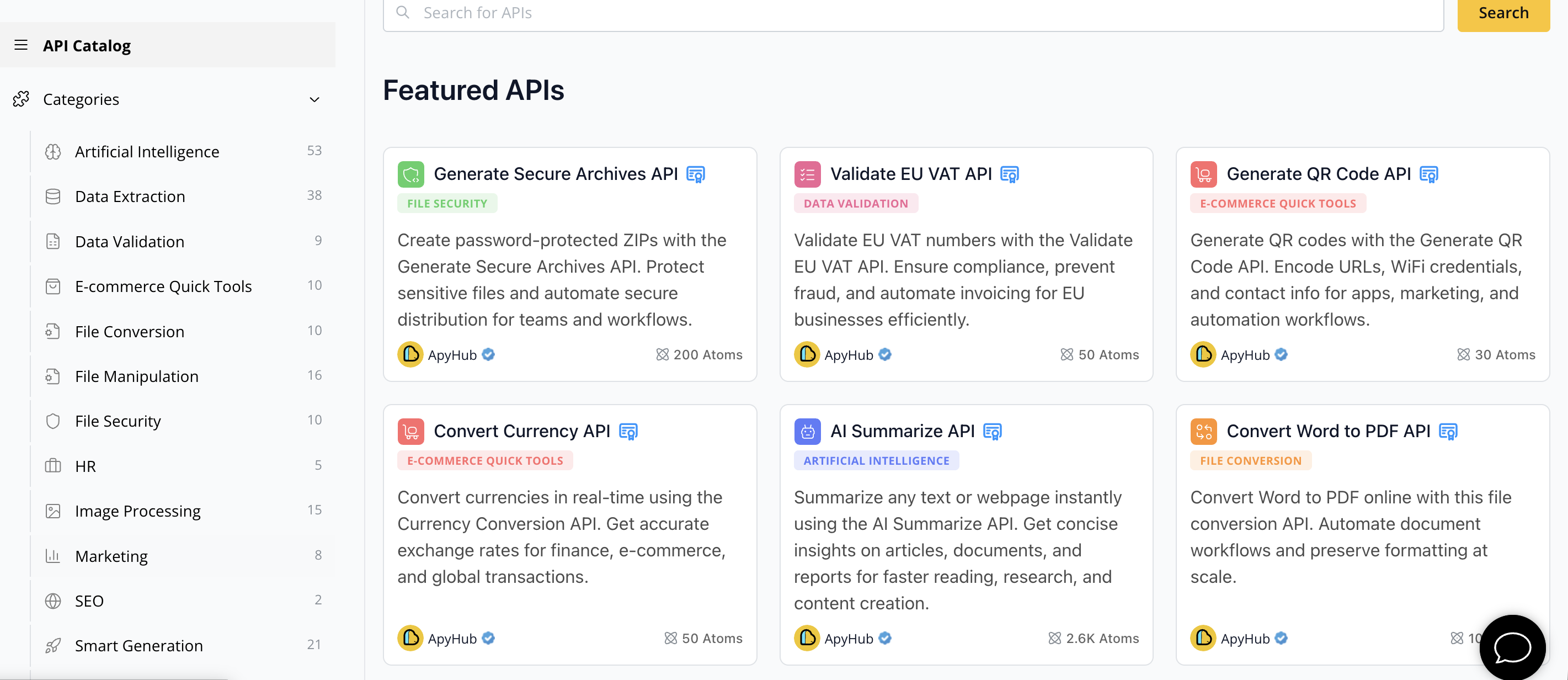
Get started by browsing our comprehensive API catalog and discover how to simplify your AI model selection and automation workflows. Visit ApyHub now to unlock scalable solutions crafted for developers, startups, and enterprises seeking accelerated innovation. Let us help you overcome technical challenges and deliver intelligent automation that works right out of the box.
10Frequently Asked Questions
What are the main types of AI models?
The main types of AI models include supervised learning, unsupervised learning, and reinforcement learning, each defined by different learning paradigms and use cases.
How should I choose an AI model for my specific task?
When selecting an AI model, consider the task requirements, the nature of your training data, and the computational resources available to ensure optimal performance and efficiency.
What are common pitfalls to avoid when integrating AI APIs?
Common pitfalls include algorithmic bias, model hallucination, and inadequate validation mechanisms. It is essential to implement a comprehensive risk assessment and monitoring systems.
Why is it important to conduct pilot tests with AI models?
Conducting pilot tests helps empirically validate the performance of multiple AI models before full-scale deployment, allowing for comparisons in precision, efficiency, and alignment with specific use case requirements.