Country Codes Explained: Powering Global API Integration
Most American tech startups face hidden complexity when integrating global country codes into user data and commerce platforms. Nearly every digital transaction across borders depends on accurate country code mapping, yet mismatched standards cause surprising issues for software developers and product managers. This guide reveals how precise country code usage in APIs can enhance reliability, prevent costly errors, and support seamless international scaling, especially when handling diverse regions and payment systems.
01Table of Contents
- What Are Country Codes And Why They Matter
- Key Types: Iso, Calling Codes, Numeric
- How Country Codes Work In Apis
- Selecting And Mapping Country Code Data
- Commerce And User Data Integration Scenarios
- Common Pitfalls And Best Practices
02Key Takeaways
| Point | Details |
|---|---|
| Importance of Country Codes | Country codes are essential for global communication, digital infrastructure, and data exchange across various systems. |
| Types of Country Codes | The main formats include ISO alpha-2, alpha-3, and numeric codes, each serving distinct purposes in digital applications. |
| API Integration Practices | Developers should implement multiple country code formats and validation mechanisms to enhance data integrity and usability in applications. |
| E-Commerce Impact | Using country codes facilitates localization, fraud prevention, and regulatory compliance, enhancing user experience and operational efficiency. |
03What Are Country Codes and Why They Matter
Country codes are standardized letter or number combinations used to uniquely identify nations worldwide. These compact identifiers play a critical role in global communication, digital infrastructure, and cross-border technological systems. International standards organizations have developed comprehensive systems to ensure precise, consistent country representation across multiple domains.
The most common types of country codes include two-letter alpha-2 codes, three-letter alpha-3 codes, and three-digit numeric codes. Two-letter codes like "US" for United States or "CA" for Canada are widely used in internet domains, postal systems, and international banking. Three-letter codes provide more mnemonic associations, while numeric codes offer script-independent representation for complex data systems.
For software developers and product managers working on global platforms, understanding country codes is essential. These codes enable accurate geolocation, support multilingual interfaces, facilitate international payment processing, and ensure seamless data exchange across different systems and platforms. They serve as a universal language for identifying nations, reducing ambiguity and preventing errors in international digital transactions.
Pro Tip: When implementing country codes in your API or application, always validate and standardize input using official ISO 3166 references to prevent potential data inconsistencies.
04Key Types: ISO, Calling Codes, Numeric
Country codes are complex systems with multiple standardized identification methods designed to support global communication and data exchange. Internationally recognized standards define three primary code formats: ISO alpha-2, alpha-3, and numeric codes, each serving distinct technological and administrative purposes.
ISO alpha-2 codes are two-letter abbreviations like "US" for the United States and "JP" for Japan, which are most commonly used in internet domains, postal systems, and general international applications. Alpha-3 codes, such as "USA" or "JPN", provide more precise country identification with enhanced mnemonic qualities. The three-digit numeric codes, conversely, offer a script-independent representation that remains consistent even when country names or alphabetic representations change.

Calling codes represent another critical country identification system, primarily used for international telecommunications. These numeric prefixes indicate the telephone country code needed to dial a specific nation from abroad. For instance, the United States has the calling code +1, while India uses +91. Unlike ISO codes, calling codes are managed by the International Telecommunication Union and reflect the specific telecommunications infrastructure of each country.
Here's a comparison of the main country code formats and their typical applications:
| Code Format | Example | Primary Use Case | Managing Organization |
|---|---|---|---|
| ISO Alpha-2 | US | Internet domains, banking | ISO |
| ISO Alpha-3 | USA | Regulatory filings, travel docs | ISO |
| Numeric | 840 | Databases, script independence | ISO |
| Calling Code | +1 | International dialing | ITU |
Pro Tip: When developing international software or APIs, always maintain multiple country code formats to ensure maximum compatibility and flexibility across different global systems.
05How Country Codes Work in APIs
In modern software development, country codes serve as essential standardized identifiers for integrating global data across different platforms and services. Public data APIs leverage these codes to enable seamless information retrieval, validation, and cross-system communication. Developers can use these codes to quickly map, filter, and categorize country-specific information without complex manual processing.
Typical API implementations involve multiple methods of country code usage. When making API requests, developers can include country codes as query parameters, path variables, or within request bodies. For example, an e-commerce platform might use the two-letter ISO code "US" to retrieve shipping rates, tax information, or localized product details specific to the United States. Most robust APIs support multiple code formats - alpha-2, alpha-3, and numeric - to provide maximum flexibility for different integration scenarios.
Authenticated and public APIs often include comprehensive country metadata alongside these codes. Beyond simple identification, these endpoints can return additional details like country names, regions, geographic coordinates, currency information, and language specifications. This rich contextual data allows developers to build more intelligent, location-aware applications that can dynamically adjust content, pricing, or user experience based on the detected country context.
Pro Tip: Always implement multiple country code validation checks in your API integration to handle potential variations and ensure robust, error-resistant data processing.
06Selecting and Mapping Country Code Data
Developers working with global data must master the art of selecting and mapping country codes with precision and reliability. International standards provide comprehensive datasets that enable seamless integration across different platforms and systems. These datasets come in multiple formats like XML, CSV, and XLS, allowing flexible implementation in various programming environments and database architectures.
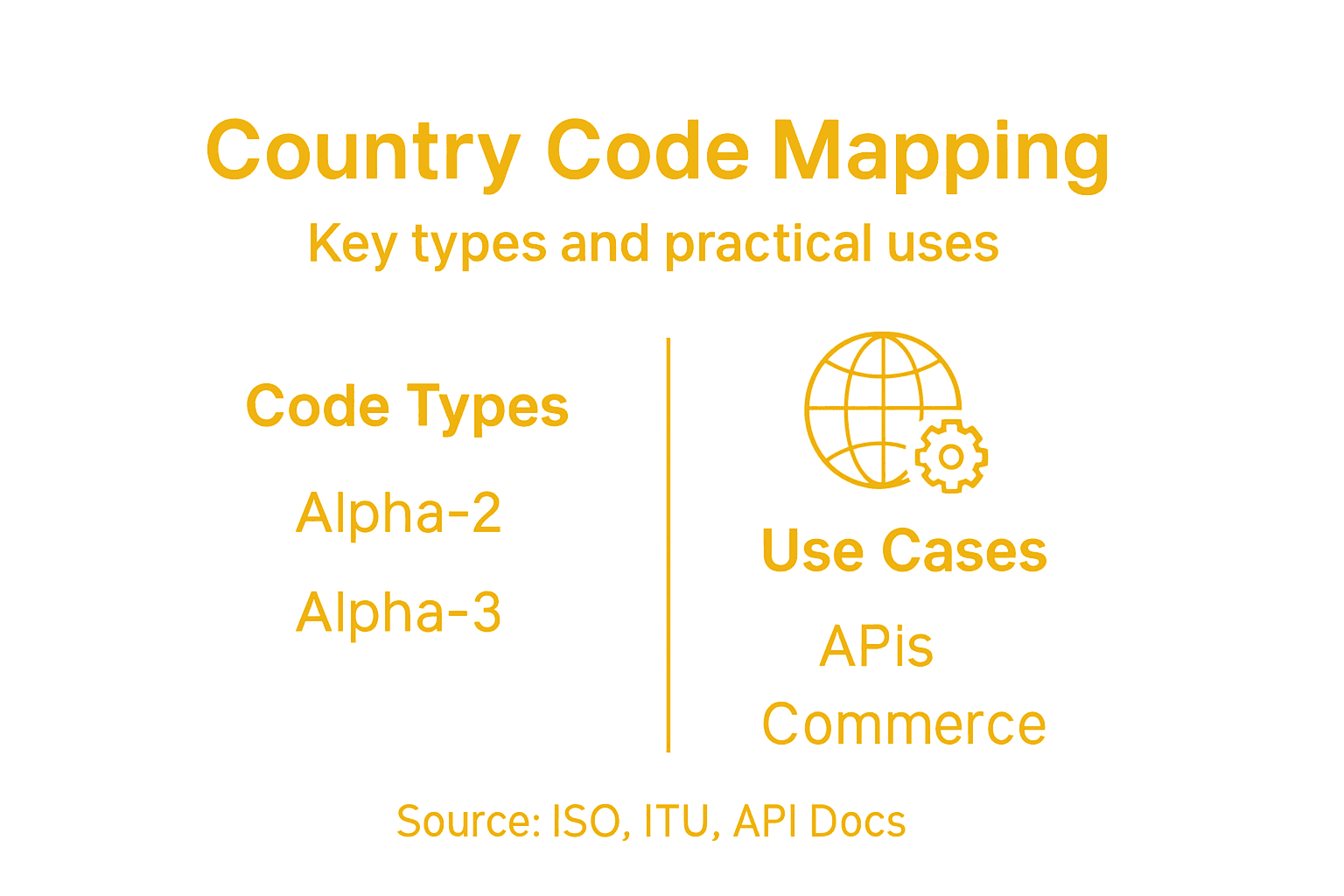
Effective country code mapping involves understanding the nuanced differences between code types. Alpha-2 codes offer concise two-letter representations, while alpha-3 codes provide more descriptive identifiers. Numeric codes ensure script independence, making them valuable for multilingual applications. Developers must consider factors like data consistency, historical code changes, and specific use case requirements when selecting the most appropriate code format for their project.
Advanced mapping strategies involve cross-referencing multiple authoritative sources to validate and enrich country code data. Some APIs and databases offer additional metadata such as geographic coordinates, currency information, and administrative subdivisions. This contextual information allows developers to build more intelligent systems that can dynamically adapt to different international contexts, supporting complex global application architectures that require precise location-based processing.
Pro Tip: Create a centralized country code mapping utility in your codebase to standardize code conversions and reduce potential integration errors across different system components.
07Commerce and User Data Integration Scenarios
Country codes are fundamental to streamlining digital commerce and user data management across global platforms. International trade systems rely on these standardized identifiers to enable precise tracking, localization, and regulatory compliance for businesses operating across multiple regions. These codes transform complex international transactions into manageable, structured data points that support seamless cross-border interactions.
In e-commerce applications, country codes power critical functionalities like dynamic pricing, tax calculation, shipping logistics, and personalized user experiences. An online retailer can automatically adjust product prices, apply region-specific discounts, calculate appropriate tax rates, and determine shipping costs based on the user's detected country. Moreover, these codes support fraud prevention mechanisms by enabling real-time verification of user location and payment origin, helping businesses mitigate risks associated with international transactions.
User data integration scenarios leverage country codes to create more intelligent, context-aware digital experiences. Applications can dynamically customize content, language settings, payment methods, and regulatory compliance based on the user's national context. Financial services, for instance, can use these codes to implement region-specific authentication protocols, display localized currency information, and ensure compliance with national banking regulations. This granular approach transforms generic platforms into sophisticated, culturally intelligent systems that can adapt in real-time to diverse global user bases.
This table summarizes business benefits enabled by proper country code usage:
| Business Functionality | Role of Country Codes | Impact on Operations |
|---|---|---|
| Dynamic pricing | Maps prices to regions | Increases revenue accuracy |
| Regulatory compliance | Identifies jurisdiction | Reduces legal risk |
| Localization | Adjusts content and language | Improves user experience |
| Fraud prevention | Verifies user location | Lowers transaction risk |
Pro Tip: Implement a robust country code validation layer that can handle edge cases like disputed territories, geopolitical changes, and multiple code formats to future-proof your data integration strategy.
08Common Pitfalls and Best Practices
Developing robust country code integrations requires a comprehensive understanding of potential challenges and strategic mitigation approaches. API security protocols emphasize the critical importance of implementing rigorous validation and authorization mechanisms to prevent data vulnerabilities and unauthorized access. Developers must approach country code integration with a multilayered security strategy that anticipates and neutralizes potential exploitation vectors.
Common pitfalls in country code implementation include insufficient input validation, inconsistent data normalization, and inadequate handling of geopolitical complexity. Developers frequently encounter challenges with edge cases like contested territories, geopolitical changes, and variations in code standards. These issues can lead to data inconsistencies, incorrect routing, and potential compliance violations. Implementing a comprehensive validation framework that supports multiple code formats, handles historical changes, and cross-references authoritative sources becomes essential for maintaining data integrity.
Best practices demand a proactive and systematic approach to country code management. This includes maintaining a centralized, regularly updated reference database, implementing strict input sanitization, supporting multiple code formats, and designing flexible validation logic that can accommodate geopolitical nuances. Comprehensive error handling, logging mechanisms, and periodic data audits help ensure that country code integrations remain accurate, secure, and adaptable to evolving global landscapes.
Pro Tip: Create an abstraction layer for country code handling that encapsulates complex validation logic, making it easier to update and maintain across different system components.
09Simplify Your Global API Integration with Ready-to-Use Solutions
Managing complex country code standards like ISO alpha-2, alpha-3, numeric, and calling codes can slow down your development process and introduce costly errors. If you are tackling challenges such as validating multiple country code formats, handling geopolitical changes, or integrating location-aware features, you need a reliable way to streamline these tasks without sacrificing accuracy.
ApyHub offers a vast marketplace of APIs designed to accelerate global commerce, user data integration, and internationalization workflows. With APIs tailored for commerce data like currency conversions and barcodes, you can ensure your applications adapt dynamically to regional differences proven by real-world use cases. Explore our API catalog to connect effortlessly with trusted APIs that handle the heavy lifting of country code mapping, validation, and multi-format support.
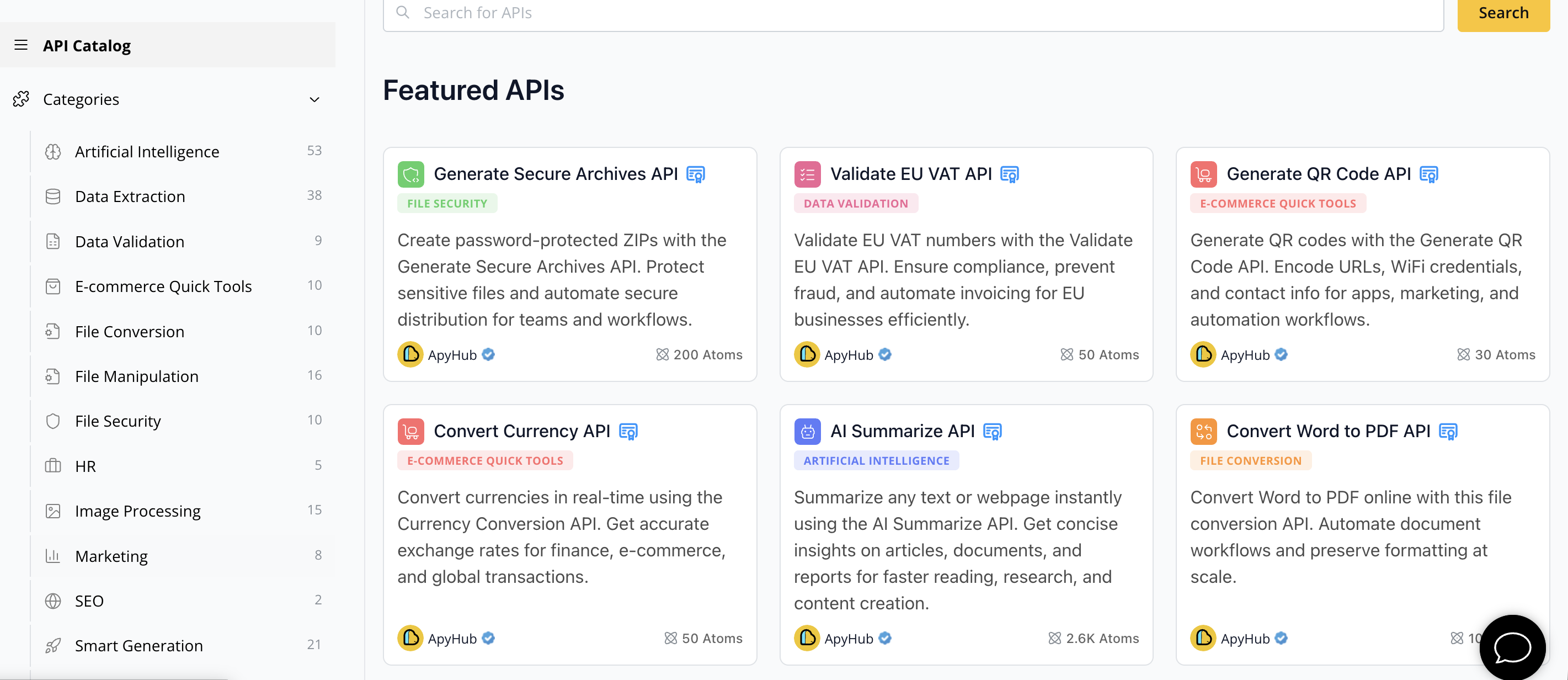
Don't let country code complexities hold back your global ambitions. Start building smarter, faster, and with confidence by accessing powerful APIs that integrate seamlessly into your applications. Visit ApyHub now and discover how you can radically reduce development time while enhancing accuracy for all your international API needs.
10Frequently Asked Questions
What are country codes and why are they important?
Country codes are standardized alphanumeric combinations that uniquely identify nations around the world. They are important because they facilitate global communication, support international transactions, and ensure accurate data exchange across various platforms and services.
What are the different types of country codes?
The main types of country codes include ISO alpha-2 codes (two-letter), ISO alpha-3 codes (three-letter), numeric codes (three digits), and calling codes (numeric prefixes for telecommunications). Each type serves distinct applications in digital infrastructure and international interactions.
How do country codes work in APIs for international data integration?
In APIs, country codes serve as standardized identifiers, enabling seamless retrieval and categorization of country-specific information. They allow developers to dynamically adjust content and processes based on user location, enhancing user experience and operational efficiency.
What are some best practices for implementing country codes in software development?
Best practices include maintaining a centralized reference database, implementing strict input validation, supporting multiple code formats, and designing flexible validation logic to accommodate geopolitical complexities. Regular audits and updates are essential for maintaining data accuracy and security.