
7 Essential API Security Best Practices for Developers
Most API breaches stem from overlooked authentication flaws, leaving sensitive data vulnerable for american companies and their global peers. For software developers and product managers at startups, securing API connections is not a luxury but a mission-critical task. This guide cuts through complexity to show you proven techniques for protecting API endpoints, validating inputs, and handling sensitive information with confidence.
01Table of Contents
- Understand And Use Strong Authentication Methods
- Always Validate And Sanitize API Inputs
- Apply Proper Rate Limiting To APIs
- Implement Least Privilege Access Controls
- Use Encryption For Data In Transit And At Rest
- Monitor And Log API Activity Continuously
- Regularly Update And Patch API Dependencies
02Quick Summary
| Key Insight | Explanation |
|---|---|
| 1. Use Strong Authentication Methods | Implement multi-layered verification strategies to ensure secure access to your APIs and protect sensitive data. |
| 2. Validate and Sanitize Inputs | Always validate and sanitize API inputs to prevent injection attacks and safeguard system integrity. |
| 3. Implement Least Privilege Access | Grant minimum necessary permissions to users and applications to limit potential security risks and breaches. |
| 4. Apply Rate Limiting | Employ rate limiting to protect against abuse, ensuring equitable access while maintaining system performance. |
| 5. Monitor and Log API Activity | Continuously monitor and log API interactions to identify suspicious activities and enhance security protocols. |
031. Understand and Use Strong Authentication Methods
Authentication serves as the critical first line of defense in protecting your API infrastructure from unauthorized access. Implementing robust authentication methods ensures that only verified users and applications can interact with your sensitive data and systems.
Strong authentication goes beyond simple username and password combinations. Modern API security demands multi-layered verification strategies that include multiple authentication factors and protocols. These approaches validate user identity through combinations of something a user knows (password), something they have (mobile device), and something they are (biometric data).
The most secure authentication methods leverage bearer token authentication which provides a standardized mechanism for granting access tokens. Bearer tokens are encrypted credentials that represent a specific user's permissions and can be easily validated by the server without storing extensive user information.
Key authentication strategies developers should consider include:
- OAuth 2.0 Protocol: Industry standard for secure authorization
- JSON Web Tokens (JWT): Compact method for securely transmitting user claims
- Two Factor Authentication (2FA): Requires two separate verification methods
- Biometric Verification: Uses unique physical characteristics for access
Implementing these methods requires carefully designing your authentication workflow. Start by selecting a robust token management system that supports secure token generation, transmission, and validation. Ensure tokens have short expiration windows and implement refresh mechanisms to maintain security.
Pro tip: Always rotate authentication credentials regularly and implement strict token revocation policies to minimize potential security vulnerabilities.
042. Always Validate and Sanitize API Inputs
Input validation and sanitization represent critical defensive strategies in protecting your API from potential security vulnerabilities. Every unverified input represents a potential gateway for malicious attacks that could compromise your entire system.
At its core, input validation ensures that all incoming data meets specific predefined criteria before processing. This means checking data types, formats, ranges, and ensuring that inputs conform to expected patterns. Validation acts as your first line of defense against various injection attacks and unexpected system behaviors.
Developers must implement comprehensive validation strategies that include:
- Type checking: Confirming data matches expected format
- Range validation: Ensuring numeric inputs fall within acceptable limits
- Length restrictions: Preventing excessively long input strings
- Pattern matching: Validating inputs against specific regex patterns
Sanitization goes beyond validation by actively cleaning and transforming potentially dangerous inputs. This process involves removing or neutralizing special characters, escaping potentially harmful syntax, and automating URL validation to prevent injection attacks.
Server side validation remains paramount since client side checks can be easily bypassed. Implement strict validation frameworks that reject any input not meeting precise specifications, effectively blocking potential security threats before they enter your system.
Pro tip: Design your validation logic to fail closed rather than open meaning reject anything that does not explicitly meet your defined acceptable input criteria.
053. Apply Proper Rate Limiting to APIs
Rate limiting serves as a critical defensive mechanism that protects your API infrastructure from potential abuse, performance degradation, and unexpected traffic surges. By implementing intelligent restrictions on API request volumes, you safeguard system resources and ensure equitable access for all users.
Effective rate limiting goes beyond simple request counting. Modern rate limiting strategies leverage sophisticated algorithms that analyze traffic patterns, user behaviors, and system capacity. REST API rate limits provide a structured approach to managing access and preventing potential system overloads.
Key considerations for implementing robust rate limiting include:
- Granular control: Set different limits for various API endpoints
- Dynamic thresholds: Adjust limits based on current system performance
- Clear communication: Provide informative headers about current rate limit status
- Graceful handling: Return meaningful HTTP status codes when limits are exceeded
Developers can choose from multiple rate limiting algorithms depending on specific requirements:
- Fixed window: Simple method tracking requests within fixed time intervals
- Sliding window: More accurate approach that prevents request spikes
- Token bucket: Allows burst traffic while maintaining overall request rate
- Leaky bucket: Smooths out request traffic to prevent sudden surges
Implementing rate limiting requires careful planning to balance system protection with user experience. Configure your API gateway to enforce these limits transparently, ensuring users understand their access constraints without experiencing abrupt service interruptions.
Pro tip: Always design rate limiting strategies that provide clear feedback to users about their current request status and remaining quota.
064. Implement Least Privilege Access Controls
Least privilege access represents a fundamental security strategy that minimizes potential damage from unauthorized system interactions. By granting users and applications only the absolute minimum permissions required to complete their specific tasks, you create a robust defense against potential security breaches.
The core principle of least privilege is simple yet powerful: restrict access rights for users, accounts, and applications to the bare essential level needed for their intended function. Least privileged access strategies provide a critical framework for reducing your overall security risk.
Implementation strategies include:
- Granular permission mapping: Define precise access levels for each role
- Regular permission audits: Continuously review and trim unnecessary privileges
- Time limited access: Create temporary credentials with expiration windows
- Separation of duties: Distribute critical system functions across multiple roles
Key considerations for implementing least privilege access controls:
- Start with zero access and incrementally grant specific permissions
- Use role based access control (RBAC) frameworks
- Implement multi factor authentication for privileged accounts
- Create detailed logging for all permission changes
Developers should focus on creating permission models that are both secure and flexible. This means developing dynamic authorization systems that can quickly adapt to changing user roles and organizational needs while maintaining strict security protocols.
Pro tip: Conduct quarterly comprehensive reviews of user and application permissions to identify and immediately remove any unnecessary or outdated access rights.
075. Use Encryption for Data in Transit and at Rest
Encryption serves as the ultimate shield protecting your sensitive data from unauthorized access and potential breaches. By transforming readable information into complex coded formats, you create multiple layers of security that safeguard data across different states and transmission channels.
Modern encryption strategies protect information in two critical states: during transmission and while stored on systems. Data in transit encryption prevents malicious actors from intercepting or manipulating sensitive information as it moves between networks and devices.
Key encryption strategies include:
- Transport Layer Security (TLS): Secure communication protocols
- Advanced Encryption Standard (AES): Robust encryption algorithm
- Hardware Security Modules: Dedicated cryptographic protection devices
- End to end encryption: Complete data protection across transmission
Implementation considerations for comprehensive data encryption:
- Use HTTPS for web communications
- Apply AES 256 bit encryption for data storage
- Implement secure key management practices
- Rotate encryption keys regularly
- Use virtual private networks for remote access
Developers must consider encryption not just as a technical requirement but as a fundamental approach to protecting user trust and organizational data integrity. Encryption should be viewed as a continuous process that adapts to evolving security landscapes.
Pro tip: Always separate encryption keys from encrypted data and store them in secure hardware security modules to minimize potential compromise risks.
086. Monitor and Log API Activity Continuously
Continuous monitoring and logging represent the central nervous system of your API security infrastructure. By tracking every interaction and transaction, you create an essential early warning mechanism that detects potential security threats before they can cause significant damage.
Comprehensive API monitoring goes beyond simple tracking. API activity management transforms raw data into actionable intelligence that helps developers understand system performance and identify potential vulnerabilities.
Critical aspects of effective API monitoring include:
- Detailed transaction logs: Record every API request and response
- Performance metrics: Track response times and system load
- Error tracking: Capture and analyze system exceptions
- User behavior analysis: Identify suspicious access patterns
Key implementation strategies:
- Use centralized logging platforms
- Set up real time alerts for anomalous activities
- Implement automated log analysis tools
- Create comprehensive dashboards for visualization
- Retain logs for forensic and compliance purposes
Developers should design monitoring solutions that provide granular insights without creating significant system overhead. This means selecting lightweight logging mechanisms that capture essential data efficiently and can scale with your API infrastructure.
Pro tip: Configure monitoring systems to automatically generate incident reports and trigger predefined response protocols for detected security anomalies.
097. Regularly Update and Patch API Dependencies
Keeping API dependencies current represents a critical defensive strategy against potential security vulnerabilities and system performance issues. Outdated libraries and packages can become significant entry points for potential security breaches and unexpected system behaviors.
Dependency management is not a one time task but an ongoing process that requires systematic attention and proactive monitoring. PATCH vs PUT API strategies highlight the nuanced approaches developers must take when maintaining software components.
Key strategies for effective dependency management include:
- Automated scanning tools: Continuously monitor dependency health
- Semantic versioning: Understand and manage version compatibility
- Security advisory subscriptions: Stay informed about potential vulnerabilities
- Staged rollout testing: Validate updates before production deployment
Implementation best practices involve:
- Create automated dependency update workflows
- Use lock files to maintain consistent dependency states
- Implement comprehensive testing before integration
- Schedule quarterly dependency audits
- Prioritize security patches over feature updates
Developers should treat dependency updates as a critical aspect of ongoing system maintenance. This means developing a systematic approach that balances security improvements with system stability and minimal disruption.
Pro tip: Establish a dedicated weekly or biweekly dependency review process that includes automated vulnerability scanning and controlled update implementation.
Below is a comprehensive table summarizing the essential recommendations for enhancing API security as discussed in the provided article.
| Security Measure | Core Concept | Key Implementations | Advantages |
|---|---|---|---|
| Strong Authentication | Employ multi-layered authentication methods to ensure user identity. | Utilize OAuth 2.0, JSON Web Tokens (JWT), two factor authentication (2FA), and biometric verification. | Enhances access control and systems protection from unauthorized use. |
| Input Validation and Sanitization | Verify and clean incoming data to protect against injection attacks and system compromises. | Validate input types, ranges, lengths, and patterns; sanitize by removing harmful elements. | Prevents exploitation through malicious inputs. |
| Rate Limiting | Restrict API access to prevent resource overuse and maintain performance. | Implement algorithms such as fixed window, sliding window, and token bucket; enable transparent user feedback. | Ensures equitable access and defends against system overloads. |
| Least Privilege Access | Limit user and application permissions to minimum required levels. | Employ RBAC frameworks, conduct regular audits, and establish time-limited permissions. | Reduces damage potential from breaches. |
| Data Encryption | Secure sensitive information at rest and in transit. | Use TLS, AES-256, and secure key management practices; leverage hardware security modules. | Protects data integrity and confidentiality. |
| Continuous Monitoring | Maintain comprehensive activity logging to identify and mitigate risks in real-time. | Centralize logs, automate analysis, set real-time alerts, and retain historical records. | Enables proactive issue resolution and compliance adherence. |
| Regular Updates | Keep all dependencies updated to defend against vulnerabilities. | Automate scans, subscribe to security advisories, and test changes before deployment. | Maintains robust and secure system integrity. |
10Strengthen Your API Security with Ready-to-Use Solutions from ApyHub
API security is a critical challenge for developers aiming to protect sensitive data and ensure reliable application performance. From implementing strong authentication methods like bearer tokens and OAuth 2.0 to continuously monitoring API activity and applying strict rate limiting, the security best practices highlighted in this article demand effort and expertise. Reducing your development time while maintaining these high standards can feel overwhelming.
ApyHub offers a powerful marketplace of over 150 APIs designed to help you accelerate secure integrations with minimal hassle. Whether you need robust authentication tools, efficient data extraction, or secure file manipulation, our trusted APIs provide practical solutions that align with essential API security strategies. Explore categories like file security and manipulation or data extraction to implement proven security workflows that protect your systems effortlessly.
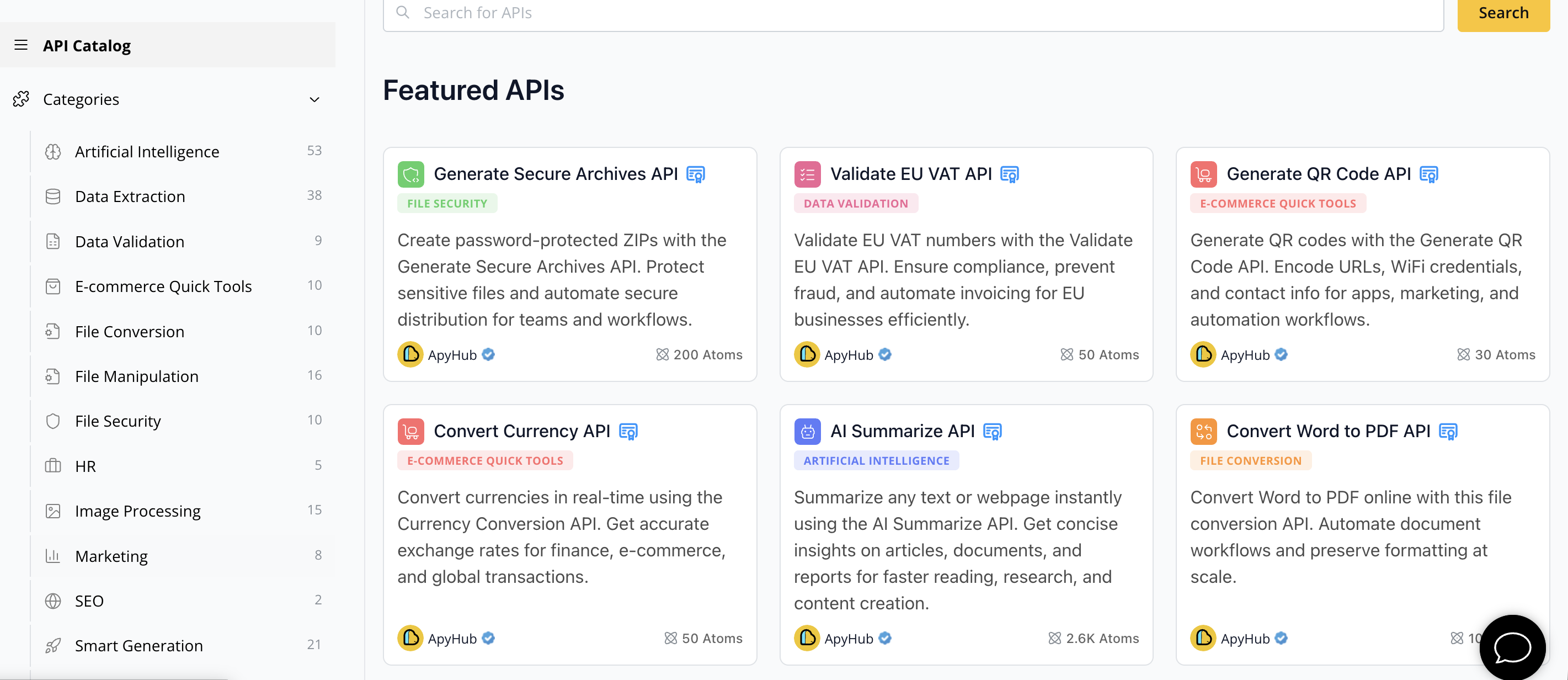
Start securing your APIs today by connecting with reliable, ready-to-use APIs on ApyHub. Save time and reduce risks by adopting intelligent security components built for real-world use. Visit our catalog now to find the perfect API integration that supports your development goals and enhances your application protection.
11Frequently Asked Questions
What are the most effective authentication methods for securing an API?
Implement strong authentication methods such as OAuth 2.0 and Two Factor Authentication. Ensure your API validates user identity using multiple factors, which enhances security against unauthorized access.
How can I ensure all API inputs are safe and properly validated?
Always validate and sanitize incoming API inputs to prevent malicious attacks. Implement strict criteria for data type, format, and predefined patterns to protect against vulnerabilities.
What should I know about rate limiting for my API?
Rate limiting is essential to prevent abuse and maintain performance for all users. Set clear, dynamic thresholds based on user behavior and system capacity, and communicate these limits to users effectively.
How do I implement least privilege access controls effectively?
To implement least privilege access, restrict user permissions to only what is necessary for their tasks. Regularly review and adjust these permissions to ensure ongoing compliance and security.
Why is encryption important for API security?
Encryption protects sensitive data both in transit and at rest by transforming it into a coded format. Use protocols like HTTPS and AES to safeguard information, ensuring that unauthorized users cannot access it even if they intercept it.